Well, if you have been paying close attention to the news, you might have noticed the "economic turmoil" or "economic depression" or "economic breakdown" which is wreaking havoc in the US and indirectly the whole world. However, with the stock markets climbing again, and companies re-hiring again, and thanks to the "bail-outs" from the various governments of the world, things seemed to have turned windward again. You are probably saying to yourself that president Obama, has taken care of this crisis and so has our PM Manmohan Singh and finance minister Pranab Mukherjee, right? Not quite. Some of my friends have been telling me, that their relatives and friends are all saying, "Things are alright in the US. Things have come(or are coming) back to normal". I agree, things do seem to be returning to normal. But, reading the article in Fortune Magazine by Warren Buffett and hearing the opinions of the economic experts, who are sceptical about the validity of the Keynesian economics school of thought made me realize that the "feeling" might not be entirely true and might only be skin deep.
Before I go any further I shall first state my opinion - "Going to US at this point of time might not be a prudent move because":
- Financial unpredictablity of the US - fears of another financial crisis, and fears over US governments inability to come out of the current one too. Who are the ones being so fearfull, you ask? The citizens of US, foreign businesses, investors, international banks to name a few.
- Social Insecurity in the US - fear of revolts, protests, public demonstrations etc. as a consequence of the financial crisis. I m sure that you wouldn't want to be in their line of fire when this happens. I don't. I m sure you have heard of the "Tea Party Protests". Many of them have taken place in many places in US already, many are more likely to come. You should look into it if you have not done yet. And then there is the tension and outcry over evictions and foreclosures, which is really very awful. I can't imagine how it would feel to loose a house by force in which I have lived for so long. The moral and social implications are yet to be witnessed, and hopefully the evicted victims get compensated. No one deserves such a treatment. But so far, to my knowledge, the people who have lost their houses have not received any sort of help from the governments yet.
- Possibility of a major change in the standard of living and lifestyle of the citizens of US - an undeniable fact, US is no longer the country it used to be 10 years back, in terms of the lavish lifestyle and the high standards of living that they used to have till now, the middle class in the US is stuggling to survive and be counted as middle class.
Having stated my opinion, in a condensed manner, now let me try to justify my stand, by stating the facts, which are easily verifiable, with the help of an internet search engine like google or wikipedia. Please note that, hereupon, for most part of rest of this post, I ll be stating the facts, not my opinions. I explicitly mention where ever I give my opinions.
Problems Caused By US Trade Deficits:
Now, lets go back to the article by Mr.Buffet.
Now, the article was written in 2003 and this is 2010. So, is there any real use of trying to gain inference from it today? Yes, there is, because so far the US government has done a lot to stop the slide, but, it still has not addressed the problems stated in that article.
Let me first sum up the article for you. You can yourself analyse and verify whether the conclusions I draw are valid or not. The article states that the US Trade deficit(i.e the imports exceed the exports) in the US is growing and this is a bad thing for US economy. He then goes on to explain, how this trend can "sell out" the entire country and explains the manner in which this could occur. Of course the scenario taken by Mr.Buffet is a very simplified one, but when one actually substitutes, US in place of "Squandersville" and countries like France, UK, Germany , Sweden, Japan, South Korea, Saudi Arabia, China, India in place of "Thriftsville", it is then, we begin to understand the ramifications of this dire situation.
In the article squandersville has an indigenous economy. As long as they are productive nothing goes wrong. But then, the thriftville people, who are also self-sufficient begin to work extra hard, so hard infact, that they begin to offer services to the people of squandersville. The squanderville people stop being productive and are happy that their work is being done by thriftsville. Overtime the people of thriftsville ask for payment of their services. To pay the squanderville people begin to sell their only asset, their land. And slowly but steadily the entire squandervilles land legally becomes thriftvilles lands. Sqandersville has been conquered not by conquest, but legally by purchase.
Mr.Buffet then goes on to give a solution to this problem of growing deficit, which seems pretty logical, and though it would be quite painful to the citizens of US, in the long run it would stop the growth of trade deficit, if not, reduce it.
If we look at this New York Times article and the article stating Obama's "Action Plan" to increase the exports,(and only look at the facts and stay neutral towards the opinions) We see that, the president is trying to increase the export by trying to control China's policies and currency. He blames the cause of the current trade deficit on China, stating the unfair advantage China has over US. Also US plans to create new markets, most probably in African countries. While this is a viable way to increase the exports, its not really a practical one. Because, sooner or later, US will again go back to the same state, after it has flooded the 3rd world country's market with its Hummers, and Coca-colas and McDonalds and Wal-Marts and Insurances and whatnot. The proper solution, in my opinion, would be to normalize the imports and exports balance "equation" with the currently actively trading nations, in a fair manner, apart from expanding into new markets, as Mr.Buffett correctly proposed. So, while the issue Mr.Buffett raised seven years ago, is being finally addressed, its actually being address in a "quick-fix" approach. Which would get US economy nowhere in the long run, in my opinion.
The Kaynesian school of economics:
The Kaynesian school of thought asks for the government intervention, to make government encourage people to spend more so that the flow of goods and services, which is "frozen" because of the "mistrust", can continue. Now this is obviously what any sane and considerate human would do, as there are millions of people who have lost their livelihood and don't have any means to earn because the banks simply don't want to loan out to even the productive people. Now, when government "pumps" money and "bails out the economy", the liquidity in market causes trade to start. Liquidity is good. So John Maynerd Kaynes actually had a great point when he proposed his economic theories, and put an end to classical economics. But what if the "bail out" leads to insolvency instead of liquidity? What am I talking about? How can "pumping" money lead to insolvency? How can an entire nation become insolvent? Well, isnt this what is happening around the world?
- US financial Crisis
- Dubai Financial Crisis
- Kuwait Financial Crisis
- Portugal Financial Crisis
- Iceland Financial Crisis
- Ireland Financial Crisis / another link on Irish debt crisis
- Italy Financial Crisis
- Greece Financial Crisis
- Spain Financial Crisis(wikipedia content because most news articles were in spanish)
Presently most nations of developed and developing world have an incredibly large amount of debt. In 2004, India had total national debt of 75% of GDP! The natural question would be... How this debt was formed? To understand this we have to take a look at how money is generated. Since the topic is related to the US, I will explain how a dollar is created in the US. The system is more or less similar in many countries, but there are a few expections as well.
So, how is dollar created? The dollar is loaned into existence. Watch the following video presentation to understand how dollar is brought into existance.
How money is created and destroyed
If you don't want to watch it, or cannot watch it(perhaps because of firewall restrictions etc). Let me explain the process of money creation.
How money is first created:
Suppose, you are a productive member of society. You live in the US. You work in a company called, lets say "big copper", which produces copper wires. Now, copper wires are used everywhere, and its demand is always there.
So, its the end of your first month of the service you managed to make copper wires worth $1200 and your employer wants to pay you money, say $1000.
To make this simpler, lets say that Big copper has sold the copper you produced directly to the US government, in their government building, for $1200. Now, the government has to pay to big copper.
This is what happens:
This is what happens:
- The government calls the US treasury and asks for $1200.
- The treasury doesn't have $1200 with them, because in practice, treasury never keeps any liquid money with it for more than a couple of weeks of working, treasury only keeps accounts of how much money came into and went out of the government. Now to get $1200 the treasury issues(prints out) a "treasury bond".
- The treasury then calls up the central bank of US(called federal reserve) and "sells" the $1200 bond paper to the federal reserve.
- The federal reserve then "loans" $1200 to the treasury and keeps the $1200 bond paper as the collateral or sells it in the FOREX.
Sounds pretty simple and straightforward. Except that Federal Reserve, even though it mints US dollars, its an autonomous entity, not owned by the government and not owned by any private bank, but it has both public and private aspects. So, the US government cannot regulate it. So, once the bonds go into the hands of the Federal Reserve, they can do with it whatever they wish to. The federal reserve generally sells these bonds to private banks and international banks. So, in effect the federal reserve sells off a fraction of US public property to private individuals. Moving on, So the federal reserve mints the $1200 and the money goes to the treasury and this money is then forwarded to the bank in which you have your account.
Now, the question remains, what gave value to the $1200 that the federal reserve loaned to the US government? The answer: Nothing. The federal reserve created $1200 out of nothing essentially. Sounds irrational and absurd? Its not. This is the fact, you can verify it yourself.
Now, Just take a look at the US dollar currency

This note is legal tender for all debts, public and privateThis is a federal reserve note, as written on the left hand top corner of the note. You got this note because the federal reserve loaned it to you, via the US government.
Now let us take a look at the US dollar note when dollar was not just a legal tender for clearing debt and actually had some value, and it was issued by the US treasury, not a central bank.

Probably the disclosure written is not visible. If you wish to read disclosure, the original large size image is available here.
The $100 note was actually a gold certificate. It states on the top and continues at the bottom, that:
This certifies that there have been deposited in the treasury of United States of America one hundred dollars in gold coin payable to the bearer on demand.Cool! there is something "physical" that is backing and limiting the value of the receipt, thus making the currency stable.
And, on the left side its written:
This certificate is the legal tender in amount thereof in payment of all debts, public or private.The original dollar was just a symbol of the true currency of trade, gold. The reason the certificate was issued was probably because it was easier to carry around than gold coins. Earlier, the dollar was based on gold and sliver. But currently its based on no valuable metal. Its essentially based on nothing. And the only thing that gives dollar its value is the federal reserve.
Because federal reserve has total control over the dollar, it can increase or decrease the flow of currency, irrespective of it having any true, tangible asset to back the currency. This is where the notion that "federal reserve creates money out of thin air" comes from and the validity this statement is quantified by the statement made by the Chicago Federal Reserve.
To further simplify the idea, this is what was published by the Federal Reserve of Boston.Neither paper currency nor deposits have value as commodities. Intrinsically, a dollar bill is just a piece of paper, deposits merely book entries. Coins do have some intrinsic value as metal, but generally far less than their face value.
- Federal Reserve Bank of Chicago, Modern Money Mechanics
(1975)
When you or I write a check there must be sufficient funds in our account to cover the check, but when the Federal Reserve writes a check there is no bank deposit on which that check is drawn. When the Federal Reserve writes a check, it is creating money.
- Federal Reserve Bank of Boston, Putting It Simply (1984)
Debt and Its nature
If you were watching the news in 2008, you might have heard that the US national debt is in trillions of dollars. This is the current national debt of US.
Look at the graph show below, its taken from the federal reserve website. And it shows net US debt (i.e all the incomes subracted from all the debts).
This is not a pretty picture, many financial experts are dismayed by these facts, and rightly so.

Note that this graph is exponential in nature. And if you recall the fundamentals of graph theory, you begin to realize how dangerous this is.
This graph is very distressing because, it shows that the debt is increasing at an exponential rate.
You might be thinking... So the growth of the debt is exponential so what? Well, the most dangerous thing about exponential functions is that things really start to go really bad really fast! Allow me to explain the extreme risk and danger of the exponential curve.
Example:Consider that there is an air tight jar and there is a type of bacteria that doubles every 1 minute and it can only survive within that jar only. Suppose that we place the bacteria within the jar at 11:00 hours and find out that the jar became full at 12:00 hours. Now I ask you, at what time would the jar be 96.325% empty? at 11:55! I hope you are able to grasp the dire implications of an exponential function with the positive growth rate. From 11:00 to 11:55 i.e for 55 minutes nothing seemed to be happening within the jar. The bacteria were all happy because there was still 96% space to move around. Then all of a sudden, in 5 minutes the jar gets full!! That is the nature of the exponential function that we don't really grasp unless we think about it.
Now, let me further try to explain the dire nature of the exponential growth rate. Now suppose the bacteria get 3 more similar jars to live in. So, now the bacteria are happy that they can live easily and free right? Wrong. Again , owing to the nature of exponential function the 3 jars will be filled by 12:02. So even if you get 3 extra jars, the bacteria would only have 2 more minutes before they run out of space. What we ought to grasp is that in the case of exponential function; the amount added for each additional unit of time increases and conversly the time difference for adding the same amount of unit decreases, i.e there is a shrinking in the time for adding same additional amount. Clearly, the action really heats up as we begin to climb the curve.
Consider another and a much more pratical example. The global human population:
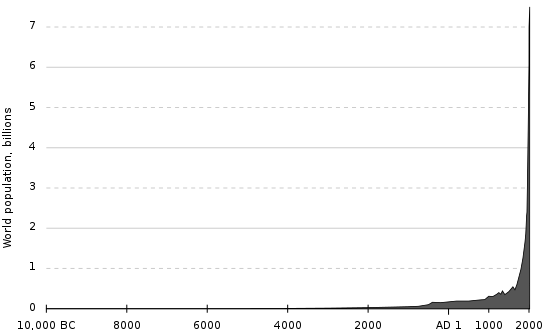
The human population is an exponential function. Its growth rate by many scientists is agreed to be averaging at 1% per year. So based on the data available we can understand that:
- It took the earth 694 years to achieve the global population(GP) of 1 billion
- It took the earth 100 years to achieve the GP of 2 billion
- It took the earth only 41 years! to reach the GP of 3 billion
- It took only 29 years to reach the GP of 4 billion
- It took only 22 years to reach the GP of 5 billion
- It took only 18 years to reach the GP of 6 billion
The next billion will take 14 years only! And already there are 6.6 billion of us on earth. Fortunately, the global population rate is reducing, but still, it will not really help once we begin to climb the curve.
The US money supply and consequentially the national debt has been increasing at alarming rate of growth. Don't want to go into the particulars of M0,M1,M2,M3 reserve money supply because it is very lengthy, if you wish to learn about that, here is the link to a good and reliable source. You many probably also need to refer to the following links as well to get the complete picture, because wikipedia only gives a very small "preview" of the actual thing. [1],[2]. Because of this, the wealth created in US will most probably have to be used by the government to service that debt. If that is the case, then we can expect a few lifestyle changes. The "cost of living" turns into "cost of survival" because, as the money supply is increasing exponentially, increasingly more amount of money is needed to be printed to service the debt, and this in turn produces more debt, and this debt again needs to be serviced with an even larger amount of money than the last one!! With every increase of money supply the US debt increases and it in turn demands further increase in money supply. Its a vicious cycle and there is no law that sets the limit on the amount of money that can exist the very design of such a system leaves out only one option to the people, to show growth in the economy. If there is no significant growth, then the debt becomes too large.
Moving on. So, essentially the US citizens owe the owners of US treasury bonds trillions of dollars. And to add insult to injury, essentially, the what the bail out did was transfer all the privately accumulated debt of private corporations like Lehman Brothers, Bear Sterns, Fannie Mae, Freddie Mac, AIG and many others, was simply transferred over to the government of USA, because they bought the toxic assets. Now what is the democratic government I ask you. The simplest definition that I can think of is;
It is an institution established which works in the interest of the people, for the people and is supposed to be run by the people of that country.And what did the bail out do? By bailing out the privately owned businesses, the government took their debt as its own, and added the bail out debt to the massive already existing debt on the heads of the people;
as if it was the fault of the people and as though the corporate mistake were caused by the people and it was the reward for the people.
The true problem with a debt based currency:
Lets move on. I explained to you that US currency is basically a debt based currency. So, all its citizens need to do is work really hard and be really productive and the debt would be paid off right? Not really. Here is the interesting part of the system. In theory this system would work like this:
Suppose, there is currently no money in the US and the world. Assume we all are US citizens and that federal reserve gave the US government $100 at a simple interest(to keep this simple, lets assume simple interest. Actually it will be compound interest) rate of 5% per annum. The government invested this money in some productive and wealth generating stuff; Like producing crops and they were expected to produce $105 worth of goods. So, lets assume that the farmer was told by the US government, "We need 105 crops to feed our country. You need to produce atleast 105 units of crops and we will sell them at $1 per unit of crop in the market". Notice that the amount generated would be just enough to clear off the debt. Now, assume that the productive venture was successful i.e the farmers managed to produce 105 units of crops. Great job! In theory the system is helping the talented and productive people "create" wealth. The wealth here being the additional 5 units of crops, which should would give the farmer an additional $5 when sold.
But here lies the problem. There is NO more than $100 circulating in the economy. But the product is supposed to be sold domestically for $105. From where will $5 come now? So, the product will have to be sold for a maximum of $100 only i.e No matter what the government does, no matter what it tries, it is not able to liberate the $5 from the "generated" 5 units of crops! Here 2 options come:
- The government undermines the value of the crop and sets the its price to $0.95 per unit of crop, to compensate for the shortage of the dollar. When it does this, it sells all the farmers crops for $100 and the wealth generated by the farmer is not appreciated. This is a very horrible thing to do, according to me, as it will discourage growth and prosperity in future.
- Suppose farmer comes to know of the governments intentions and he does not like it. The farmer is a real trooper and he fights with the government, the government bows to his demands and again here government has two choices:
- Export - trade the 5 crops for currency equivalent to $5 to a foreign country. But here too there is a problem. The domestic demand is undermined. But the money to pay off the debt is achieved.
- Borrow - the $5 is again loaned from the federal reserve. But the moment the government borrows $5 there is a 5% interest on this $5 too!
So in conclusion, no matter how productive we are, there is absolutely no way of paying off the loan without actually getting a new loan from the Federal Reserve. This loan is perpetual and there is no escaping it.
The current system does not allow its citizens to pay off the interest on the debt. So, over time the debt will grow and grow and grow as is the case in todays world.

The US Financial system only allows to repay the principal amount, but not the interest because the Federal Reserve only circulates the principle amount within the economy and not the interest amount.
To know more about the Federal Reserve's role in US economy take a look at the following report to the US congress in 1996. US economy was showing distress signals from the late 1990s but it was alledgedly swept under the rug.
Money and the Federal Reserve System: Myth and Reality by G. Thomas Woodward Specialist in Macroeconomics Economics Division July 31, 1996 Congressional Research Service Library of Congress CRS Report for Congress, No. 96-672 E.
How local banks "create" money:
Continuing with the Big Copper Story:
Now, let us understand the next stage of banking. The government had sent $1200 to Big Copper and Big Copper deposited $1000 into your account at a local bank, say that the name of this bank is "Bank A". (and kept $200 for itself; its a fair deal; no problems here).
Assume that Bank A did not have any money with it. You were its first customer. Now,a friend of yours approached the bank asking for loan because she wanted to start her own company. According to US laws, Bank A can loan out "a fraction" of the deposits it has to a person who is asking for the loan, generally against some collateral(In recent times we observed that collateral was not necessary for issuing of loans, which led to the sub-prime mortgage crisis). The minimum reserves each bank must hold to customer deposits and notes is called as reserve ratio. The reserve ratio in US is 10%. This means that if you deposit $10 in the bank, it can loan $9 and keep $1 with it as bank reserve. So, the bank loaned out $900 to your friend charged interest on that. Your friend gave it to a contractor to buy company equipments and space etc. The contractor then opened a bank account in the same bank and deposited the $900. So, contractors account showed $900. All this happened yesterday.
So this means that in effect, the bank now has $1900($1000 + $900) with it! This is what the bank will show on its books/balance sheets. It will show $900 as a deposit. Now this means that, because this $900 is treated as a new deposit, it can again a loan out a fraction of this $900- The $900 which does not actually exist because it was not actually deposited as a result of a productive venture, but is expected to be deposited in the future - to other customers of the bank. So, the bank again loans out 90% $900, i.e $810 is loaned out next. Now if this $810 is deposited in another bank or same bank. That bank again can loan it out 90% of this amount.
... The cycle keeps on repeating and repeating.
So, to summarize, this is what happens.
$1000 deposited(by you)
$900 can loaned out and if its deposited then
$810 can loaned out and if its deposited then
$729 can loaned out and if its deposited then
$656 can loaned out and if its deposited then
$590 can loaned out and if its deposited then
$531 can loaned out and if its deposited then
$478 can loaned out and if its deposited then
$430can loaned out and if its deposited then
$387can loaned out and if its deposited then
$349 can loaned out and if its deposited then
$313can loaned out and if its deposited then
$282 can loaned out and if its deposited then
$254 can loaned out and if its deposited then
$228 can loaned out and if its deposited then
$205 can loaned out and if its deposited then
$185 can loaned out and if its deposited then
$166 can loaned out and if its deposited then
$150 can loaned out and if its deposited then
$135 can loaned out and if its deposited then
$121 can loaned out and if its deposited then
$109 can loaned out and if its deposited then
$98 can loaned out and if its deposited then
$89 can loaned out and if its deposited then
$80 can loaned out and if its deposited then
$72 can loaned out and if its deposited then
$65 can loaned out and if its deposited then
$58 can loaned out and if its deposited then
$52 can loaned out and if its deposited then
$47 can loaned out and if its deposited then
$42 can loaned out and if its deposited then
$38 can loaned out and if its deposited then
$34 can loaned out and if its deposited then
$31 can loaned out and if its deposited then
$28 can loaned out and if its deposited then
$25 can loaned out and if its deposited then
$23 can loaned out and if its deposited then
$21 can loaned out and if its deposited then
$19 can loaned out and if its deposited then
$17 can loaned out and if its deposited then
$15 can loaned out and if its deposited then
$13 can loaned out and if its deposited then
$12 can loaned out and if its deposited then
$11 can loaned out and if its deposited then
$10 can loaned out and if its deposited then
$9 can loaned out and if its deposited then
$8 can loaned out and if its deposited then
$7 can loaned out and if its deposited then
$6 can loaned out and if its deposited then
$5 can loaned out and if its deposited then
$4 can loaned out and if its deposited then
$3 can loaned out and if its deposited then
$2 can loaned out and if its deposited then
$1 can loaned out and its deposited
assume there the banker decides its enough lending.
----------------------------------------------------------------------------------------------
sum = $9953
It does not matter if the loans are drawn on the same bank or a different bank. The point here is that, the total money because of these transactions became almost 10 times of the actual physical value present in the economy. In my opinion, this multiplier effect of the fractional reserve banking system is clearly a very dangerous thing. This gives a feeling to the public that there is much more money in the economy than there actually is. The money shown is the money which "will" be available some time in the future, but is not actually available in the present.
Now suppose tomorrow you will want to withdraw the $1000 from your account and close your account. Now, the bank does not have your $1000 it has lent out to others. What can the bank do now? It has to loan $1000 from someone, somewhere to pay you off. Now, when it takes the loan, the liability of the bank increases.
The banks, acting on trust, hope that one day $9953 would come from the original $1000. Thats hoping for the best. But where is the banks preparation for the worst? What if it will not come? What if your friend fails in her business venture and is not able to pay the loan, i.e defaults?If that happens then:
- The bank does not have the $1000 you gave
- And it did not get the $900 it loaned out.
- On top of that it has to pay the $1000 loan it took to pay you
This is a really messy, and sticky situation. The bank takes the $900 it loaned out. Which causes a cascading effect cause the $810 loan to fail too, because even if person pays off the dept its only $810 + some interest and thats less than $900. So this bank also goes bankrupt and the so does every other bank that was involved in this transaction, perhaps including the bank that gave $1000 to bank A to pay you off.
The only way out of this is to take more loans from the federal reserve. But, only the government can get money from the federal reserve, in exchange for treasury bonds. What does this mean? It means that the government "bails out" the banks by loaning its citizens hard earned produce(like bridges, parks, public schools, taxes) to give the money to the banks so that they keep functioning. Note that I used the phrase "give the money" not "loan the money", The federal reserve loans, but the government gives away. Fortunately, the federal reserve today is loaning money for bonds at 0 to 3.5% rate of interest only. But, it does not really make any difference. The debt is so high that the interest to the debt is already really very difficult to pay.
One more important and interesting point to note is that, if most of the nations money does not contribute to its growth, then the government will have no other way but to borrow more and more money to sustain the country's economic demands. And when this happens, the rate at which the debt grows increases. The citizens literally live on borrowed time! And eventually the phenomenon of intergenerational inequities occur.
The Problem of Inflation:
The system of creation of money without any basis or adhering to physical limits of actual assets and wealth can cause inflation or deflation artifically, meaning that inflation and deflation of prices may not be actually because of the imbalance in supply and demand of goods and services, but it can be engineered. I dont want to go in too deep on inflation, I ll make a new post explaining inflation.
All we need to understand is that, inflation is the loss in the value of your money. The result of which is the rise in the price of goods and services. Many of us think that cause of inflation is rise in the prices. No, the rise in price is the effect or symptom of inflation. So why is inflation bad? Because it devalues the money.
When the government bails out it injects billions of dollars into the economy. When this dollar is injected, though the things get moving, the billions of dollars go into the pockets of the people ultimately. So, it means more purchasing power right to the people right? Not necessarily, because now everyone has more number of dollars in their pockets. But the goods and services have not really grown as fast as dollars are being injected. The currency can no longer buy the same good at the same price. One would have to spend more to get the same thing in the same amount. Hence, currency is devalued. Looking at the trends, $1 trillion being injected to get the european markets going again and Greek treasury bonds given "junk" rating by Standard & Poor, as a consequence, proves that, all this money injection will provide the liquidity initially, and ll give a purchasing ability to the people. But ultimately it ll cause inflation and devalue the nations currency to junk.
Inflation destroys economies:
The economic effects of inflation are very dire. Historically, inflation caused a lot of pain and hardships to the citizens. Many african countries, latin american countries have very high inflation, and look at their lifestyle, and compare it to our lifestyle. You yourself will begin to realize the effects of inflation.

The photo I put above is the grim reminder of what value the inflation can give to paper money. Inflation is not just a problem in the US. How long can the US sustain itself by keeping on piling debt on itself and by injecting more and more dollars into the economy? In my opinion, not very long.
In coming years, if US economy does not turn productive, inflation will certainly rise greatly. The dollar has already began loosing its reputation. These financial threats are very real. And the people who wish to go into the belly of the beast, should be weary of these facts.
 S
SSweeping banknotes off the streets, during hyperinflation in Hungary.
Time and again the world has seen inflation destroying entire economies of entire nations, and the world ought to learn for its past mistakes and do its best to avoid getting caught in inflationary cycles. Unfortunately, most of the nations in the world are within this inflationary cycle.
I would also like to quote an observation of John Maynard Kaynes, which he made in his critically acclaimed book - The economic consequences of peace, he said:
Lenin is said to have declared that the best way to destroy the Capitalist System was to debauch the currency. By a continuing process of inflation, governments can confiscate, secretly and unobserved, an important part of the wealth of their citizens. By this method they not only confiscate, but they confiscate arbitrarily; and, while the process impoverishes many, it actually enriches some. The sight of this arbitrary rearrangement of riches strikes not only at security, but at confidence in the equity of the existing distribution of wealth. Those to whom the system brings windfalls, beyond their deserts and even beyond their expectations or desires, become "profiteers,", who are the object of the hatred of the bourgeoisie, whom the inflationism has impoverished, not less than of the proletariat. As the inflation proceeds and the real value of the currency fluctuates wildly from month to month, all permanent relations between debtors and creditors, which form the ultimate foundation of capitalism, become so utterly disordered as to be almost meaningless; and the process of wealth-getting degenerates into a gamble and a lottery.
Lenin was certainly right. There is no subtler, no surer means of overturning the existing basis of society than to debauch the currency. The process engages all the hidden forces of economic law on the side of destruction, and does it in a manner which not one man in a million is able to diagnose.
In the latter stages of the war all the belligerent governments practised, from necessity or incompetence, what a Bolshevist might have done from design. Even now, when the war is over, most of them continue out of weakness the same malpractices. But further, the Governments of Europe, being many of them at this moment reckless in their methods as well as weak, seek to direct on to a class known as "profiteers" the popular indignation against the more obvious consequences of their vicious methods. These "profiteers" are, broadly speaking, the entrepreneur class of capitalists, that is to say, the active and constructive element in the whole capitalist society, who in a period of rapidly rising prices cannot help but get rich quick whether they wish it or desire it or not. If prices are continually rising, even trader who has purchased for stock or owns property and plant inevitably makes profits. By directing hatred against this class, therefore, the European Governments are carrying a step further the fatal process which the subtle mind of Lenin had consciously conceived. The profiteers are a consequence and not a cause of rising prices. By combining a popular hatred of the class of entrepreneurs with the blow already given to social security by the violent and arbitrary disturbance of contract and of the established equilibrium of wealth which is the inevitable result of inflation, these Governments are fast rendering impossible a continuance of the social and economic order of the nineteenth century. But they have no plan for replacing it.
- Chapter VI - Europe after the Treaty,
THE ECONOMIC CONSEQUENCES OF PEACE
THE ECONOMIC CONSEQUENCES OF PEACE
The book is freely available at project Gutenberg, under project Gutenberg license. You can get the book here.
Adding 2 and 2 : So what does all mean?
Till now I stated the facts about the US economy and the dire trouble that it is in. Now let me try to relate this to Indian students going to the US.
Indian students, many of them take loans to study abroad. The system worked well till recent past because, when the students go to US they earn in dollars. And till recent past the US economy was in a bubble, so jobs were ample and the dollar was strong, the students would easily earn and pay off the loan without any problem. Now the bubble has burst, and many many experts are of the opinion that US has never encountered a bubble so large and so destructive. Earlier going abroad to study was an investment, with rich returns almost guranteed. Now its a risk on the student's future and liability on his personal or family's finance, with doubtful returns.
After the bubble burst, the unemployment rate sky-rocketed. Now, people are saying that employment is being generated again. But its really unlikely, because this employment again is created and the employee is being paid his salary with the money the company loaned. Now, Wasn't the original bubble burst which caused this crisis because of loan defaults? So, what if the company defaults again? It ll be 2007-2008 all over again. So, going out there for 2 long years atleast and maybe atleast 3 more years to "earn in dollars" and get rich, looks more like a risk, because, the economy is not really safe. The "boom" just ended and now the deflationary "bust" is occurring. To tackle this deflation, the government is pumping money. This pumping of money is only till the markets get stabilized and start to grow again. But, when the growth picks up speed, the spending will begin again and when spending begins, all the surplus dollars that were pumped during the deflation will begin to surface and when that happens there will arise a risk of inflation. And if the rate of inflation will be faster than the rate of availability of good and services, then there is nothing much that the federal reserve can do contain the inflation. And the scary part is that USA is not yet productive, reformed and efficient and the american culture so far has been known to be frivolous rather than frugal. So chances are that even when growth begins to be observed, people will start spending and this spending might make the control of inflation very difficult. This problem has not yet even begun to be seen, but it will come in the future, as a direct reaction to the stimulus(remember the fundamental law? every stimulus has a response, so it will happen, there is no denying that). And when it comes, it would pose a great challenge to the Federal Reserve and Government. How effectively they manage it depends on a great many factors that are beyond the control of US government.
Next is the national dept of US government which is inherited by its citizens. The dept is due to perpetual borrowing and trade deficits as I explained earlier. To pay the federal reserve the interest of the previously borrowed money, the US government again has to burrow more money from the fed. Ridiculous as it may sound, this is what is happening. Current public dept is 12 trillion. Suppose 2 trillion is the interest, then next year the US has to atleast borrow 2 trillion to keep going. Now, if you are planning to become a US citizen, be aware of these dire situations. Currently, the debt on every citizen in the US is a little over forty thousand dollars and its increasing. So, be prepared to pay off an ever increasing debt on your head, with no property, financial assistance, like you might have in India, to pay it off.

The value of dollar is diluting slowly in the global arena. Currently it is the global reserve currency, but if america's situation does not improve, then it might be replaced by a currency of a strong prosperous economy. If that happens then it would be disastrous for the US citizens because there would be literally hundreds of trillions of dollars which would no longer be acceptable for trade and all the nations who have saved up the dollar would ask send it back to US and ask for exchanging that for something of value, it would be really a very very scary scenario if the dollar looses its position as the global reserve currency. And the United Nations Conference on Trade and Development (UNCTAD) has called to do just that. Alternatively, the chinese yuan is a contender for becoming the next global reserve currency, provided china starts to sell its treasury bonds in market. And here is one more interesting fact; remember earlier I explained that US treasury bonds are sold to the Federal Reserve. The Federal Reserve then sells these to international banks. Guess what, currently China owns more than 40% of these US bonds!
One more aspect that the people who wish to go abroad to US should see is the is the distribution of wealth and assets within the demography.
Look at the figures below. These are all from the critically acclaimed paper by Prof. William Domhoff of the Department of Sociology, from University of California, Santa Cruz
Net worth and financial wealth distribution in the

Wealth distribution by type of asset, 2007:

Wealth distribution by type of asset, 2007:


So, if you now wish to earn lots of dollars(even though the future of dollar seems a little grim), you would need to be in the top 20% of the US wealthiest to comfortably survive. And I would like you to asses yourself of the odds of achieving that in a matter of 5 years. (Assuming that you stay for atleast 3 years to earn back what you spent).
With the growing divide between the rich and poor and an ever increasing number of foreclosures and evictions and growing discontent among the middle class in US, there is a growing tension in the poverty stricken areas, as news reports suggest. But you have to realize that these "poverty stricken areas" were not poor 5 years ago. They were converted into this post-crisis. Another morally disturbing fact is that, the companies who have received the bail out, used it TO PAY BONUSES to the executives!!! And believe me, the greed game is not over yet m there is still money to be made by the banks on the foreclosures.
And also remember that the 2nd Amendment of the US constitution is "The right of every citizen to bear arms". Now, I might be a bit too cynical about this. But, this is a risk nonetheless. We are seeing the great inequality of wealth distribution in US. There is a growing feeling of discontent among the masses of america about this.
An imbalance between rich and poor is the oldest and most fatal ailment of all republics.
Couple this unequal distribution of wealth with public debt and inflation and you get a scenario where there are plenty of dollar notes to go around, but the common people are not able to buy anything with the dollar. The people would then take to the streets and ask the government for answers. Maybe, all this would bring about anarchy for a short period of time! Who knows!!... just my opinion. I surely don't want that to happen!!
Nobody likes the people who come from outside and take their jobs... especially when there are no jobs for the citizens themselves:
The immigrants are already being frowned upon and many corporations are hesitant in employing immigrants because of the unpopularity they might attract. Getting a job in US during as well as after MS is definitely getting more and more difficult. These are trying and very frustrating times for the american citizens. Their lifestyle might soon have to change, for the worse. The americans are not used to this and this would lead to frustrations among the american public. And in worst case scenario, this might lead to friction between the immigrants and americans, and friction between the rich and the middle class and poor, and you don't want to be in the line of fire when this happens. I don't think the threat of violence, can be undermined.
If you are an internet person, and you are in touch with a few american friends, you would know that the american people are getting aware of their true financial situation and are feeling agitated about the situation. The mainstream media is continuously trying to make the world believe that US and the world is on the road to recovery, but the chain of events that are occurring(all the various crisis around the world) weave an entirely different story. The presidents approval rate has gone down to 42%.
There is tension in america, and the americans are known to stand up and rise against tyranny. This is occasion is no different. No one knows 2 years down the line, what impact the national debt, coupled with the inflation caused by the stimulus packages and wealth divide, would create. The people, frustrated, angry and desperate, might even take to the streets like they did in 1776, 1861, 1955-68. The second amendment to the US constitution allows citizens to bear arms(handguns, pistols, shortguns, rifles, rocket launchers!, M-16s!! ... you name it) and protect themselves.The citizens might not hesitate to use it to fight the misfortunes levied on them because of the mistakes of the big corporations(I ll cover bail out in my next post).
A few economists are speculating the collapse of the dollar itself, 5 years down the line.(By collapse I mean the federal reserve system. A new system should immediately take its place, as it happened in 1934 in India and in 1913 in US, 1925 in UK, but it will surely accompany a lot of chaos and confusion). If that happens, just imagine what your prospects would be. If you look back in history, germany, once the most prosperous nation during the 19th century and an economic power even today, in 1923 was marred by hyperinflation(recall the picture of the woman using german currency notes to use for heating, because wood was costlier). The fate of US may also end up the same.The situation germany faced back then, is a grim reminder of how bad things can go. It was in such a situation, that a brute like Hitler rose to power. What if another Hitler seizes power amidst the economic collapse? Remember, the euro collapse was averted with the IMF stepping in a providing 1 trillion dollars bail out. This only ll only buy time, but it will not solve the problems, but infact prolong them.
The point that I m driving at is that, US might no longer be as safe as it used to be, because of the economic problems its facing and because there is no end in sight yet for its problems. Infact, many economists predict, that US are gearing towards another economic downturn. Injecting trillions is only prolonging the problem, and postponing the actual recovery. The late Nobel laureate economist Friedrich Hayek, in his rebuttal against John Maynard Keynes ideas, explained that, "bail outs" hurt more in the long run than they benefit.
So, 2 to 3 to 5 years down the line, americas economic influence in the world might have gone down considerably. Top economists in america are saying that US is heading (see nobel laureate in economics Paul Krugman's take on current economic situation, NYTimes article, 20th May 2010) into something analogous to japans "lost decade". Going to america during this time would be quick risky. Risky in terms of the failure of your investment, risky in terms of your job prospects and prospects of work exposure in the US, and risky in terms of your personal security. The austrian school of thought in economics had predicted this the economic downturn, but their outcries were ignored. But now, lots of people are realizing their folly, and its not a surprise, because one of the giants in western philosophy once said:
All truth passes through three stages. First, it is ridiculed. Second, it is violently opposed. Third, it is accepted as being self-evident.
Conclusion:
What I personally think is this:
GRE's validity is 5 years. So, you can write the GRE test and wait and see the things as they unravel. In the mean time, you can get a job and gain experience in your field of interest or go for M.Tech in India itself. The jobs are still there in India. So, get a job and gain experience, or if you don't care for industry exposure much do your graduate and PhD in India. Also keep looking very very closely at how this economic debacle unfolds itself, from every angle possible and then judge yourself. Here is what the billionaire investor George Soros, "the man who broke the Bank of England" has to say on Indian economy:
Many economists speculate that the downturn is still continuing and it will continue to do so for a couple of years or so. Ben Bernanke , the governor of the US federal reserve himself has said
Stabilization of housing prices is the first major step towards fixing the US economy. But when this will happen is unknown.(source)So, if you ask me you would be risking your future, if you go to US now. How do you think you ll survive there, with all the chaos and confusion? When and if the dollar does collapse, then there would definitely be a lot of public outcry. There is not doubt about it, because the peoples wealth and property is at stake.
On a much more pessimistic note, financial columnist Paul B.Ferrell wrote this on the Wall Street Journal's Market Watch section:
Warning: Crash dead ahead. Sell. Get liquid. Now. (Article published on May 25th 2010).
So, in my opinion, the best thing to do right now is to get a job and get a few years of experience, because, these economic problems cannot last forever, but till they last, the entire world will suffer, there will be more job cuts and unemployment because everyone would want to cut their spending. If the dollar does collapse under its own weight, there is no doubt that another currency will take its place, because the world will not end if a currency collapses. 3800 currencies have come and collapsed prior to the dollar becoming the monetary standard of USA. I m not saying that the value of education in the US has gone down.
What I m saying is that these are trying times, and it would be downright foolish to be amidst the possible collapse of a powerful currency, and chaos which would follow as a consequence of that collapse. So, if the dollar does collapse, like euro(euro may not last another 20 years says financial advisor and investment banker Jim Rogers) almost collapsed because of greece(recall that euro has to still bear the burden of the financial problems of Spain, Portugal, Ireland, Iceland, Italy also) another currency will take its place. And after this happens, the economy will probably recover slowly. And lets face it, no matter how many degrees and certificates you have, there is nothing more valuable than experience, and if you ultimately want to work or start your own company, you ought to know that employers look for the candidates who have exposure and experience. So, gain experience, and if the situation is indeed improving as US president Obama claims(So far all the big economists, business gurus and investors are not buying his claim), then you can always pursue your goal of studying the subject of your choice after 2-3 years when things have cooled down.
May be you may perceive this as me "crying wolf" here, but looking at the way the things are and attempting to know how the financial system works, I feel that my assessment of the worst case scenario is more or less, in a broad way, accurate. If you feel or know that my assessment is incorrect, please tell me about it. However, I do wish and hope that I am wrong, along with several economists and businessmen and investors.
I would like to end this post by quoting what Christoper Martenson, the former vice-president of the international drug giant, Pfizer inc believes:
Massive change in upon us: The next 20 years will be completely unlike the last 20 years.
THE END.
Your comments and constructive criticism are welcome. If you find any facts I stated to be erroneous or any point to be contradictory, and/or needlessly biased please let me know.
I urge you, the reader to be critical of my post and do your own research and cross check every fact I have stated and draw your own conclusions and share it with me, as per your convenience.


No comments:
Post a Comment